
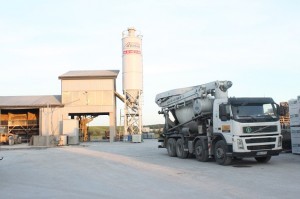
We produce concrete in two fully automated and computer controlled concrete nodes. Due to the modern plants and cooperation with checked producers and suppliers, we are sure that our company provides high quality products. Manufactured concrete mixes are verified by specialist laboratories, which ensures stable and unchangeable product parameters.
We have got a fleet of lorries for transport and pumping concrete.
Concrete blocks are made for masonry constructions, plastered and protected from atmospheric factors. The blocks are used in masonry constructions bearing loads and in constructions not bearing loads in general building.
Block weight: about 24 kg/1 piece
Number on a pallet: 54 pcs
Pallet weight: about 1320 kg
Use for 1 m2: 22 pcs
Lean concretes are produced in durability classes for compressing C8/10 and C12/15. Normal construction concretes are produced in durability classes for compressing from C16/20 to C45/55. Normal construction concretes mean, first of all:
- wide range of uses
- high quality product
- consistency providing simple laying down with use of traditional methods of compacting
- broad selection of durability classes for compressing and exposure
Normal concrete is mainly used for all construction elements, like:
- foundations
- walls, poles
- ceilings, stairs
Typical characteristics of concrete floor mix is low shrinkage during hardening, and resistance to water secretion during placing and compacting the concrete mix. The most frequently produced classes of durability for compressing are from C20/25 to C30/37. Characteristic features of concrete floor mixes are:
- reduced shrinkage (reduced risk of occurrence of uncontrolled floor cracks)
- high quality floor
- resistance to water secretion from the concrete mix during its placement
Concrete floor mix with distributed reinforcement are much more resistant to bending, hitting and mechanical damages and has got lower shrinkage than concretes without reinforcements or with traditional steady reinforcement. Concrete floor mix reinforced with distributed fibres is intended mainly for making solid and resistant to load concrete floorings and outer surfaces in industrial buildings, production halls, warehouses, shops, garages, exhibition surfaces, public utility buildings, etc.
Stabilizations - 0,5 to 5,0 MPa (0,5 - 1,5 MPa, 1,5 - 2,5 MPa, 2,5 - 5 MPa). Stabilizations are used for:
- basic beddings for road surfaces
- surface and lower auxiliary beddings of road surfaces
- beddings for surfaces of concrete and asphalt roads of huge bearing capacity
- beddings for parking lots and manoeuvring lots
Sand and cement ballasts are perfect for levelling ground under elements of small architecture (streets and gardens):
- cobblestones
- flagstones
- draining beds
- decorative elements of streets and gardens
Waterproof concrete is made to ensure required tightness, exceeding the tightness of normal concrete technologies. Waterproof concrete is utilized mainly in water constructions or on elements located below the water surface, water reservoirs and constructions especially exposed to water influence. There are specified a few levels of concrete watertightness: W2, W4, W6, W8, W10. The number means the water column pressure in MPa reacting on a 15-cm thick concrete sample. While manufacturing waterproof concrete, it is very important to ensure complete tightness, taking into account shrinkage cracks as well. In the process of concrete ripening, due to a quick loss of water and emitting heat of hydration, shrinkage micro cracks appear on the concrete. To prevent appearance of shrinkage cracks, concrete maintenance should be strictly obeyed. For waterproof concrete 14-day-long period of maintenance is recommended. After the time, shrinking will not cause crack creation, as concrete durability for cracking will be sufficient to transfer stress caused by technological strains.
Architectural concrete is used for constructing monolithic elements in the area of construction. It has also got a decorative function. It may be smooth or with a visible structure. It does not require any further finishing actions. Use of architectural concrete:
- surface layer or entire construction of internal and external walls
- elevations
- arches
- stairs
- pedestals
- individual elements